


AI in finance is still in its early stages, but the focus is already evolving. What started as a push for automation and time savings is now expanding toward prediction, protection, and strategic insight.
That shift comes through clearly in our latest Finance Labs survey of 100+ CFOs and finance leaders. They’re interested in new AI capabilities, but interest by itself isn’t enough. Teams are prepared to invest only when the results can be measured, the technology works with what they already have, and governance stays intact.
In this report, we look at what finance leaders say they’re actually planning to adopt next — and what that means for the future of AI in finance.
Future trends for AI in finance
When asked which future use cases excite them most, finance leaders showed a clear preference for tools that improve visibility and strengthen control:
- 41% said real-time anomaly and fraud detection tops their list.
- 20% selected personalized insights for decision-making.
- 16.2% want fully autonomous invoice-to-payment processes.
- 15.2% are looking for predictive cash flow and scenario planning.
- 7.6% chose AI-driven budget optimization.

These answers point in a clear direction: most CFOs aren’t chasing fully autonomous finance operations. They want AI that strengthens oversight and reduces risk, especially in areas where mistakes are expensive or hard to catch manually.
Fraud detection, anomaly alerts, and decision-support tools top the list because they solve problems finance teams face every day — gaps in visibility, unpredictable exceptions, and rising compliance demands. Automation still matters, but only when it’s layered on top of strong controls.
Kristian Gylling, CFO at Rillion, says:
“Finance teams don’t want AI to run on autopilot, they want it to help them see what they can’t see today. Fraud signals, unusual patterns, changes in behavior… these are the areas where AI can make the biggest impact. When the technology strengthens control and reduces exposure, that’s when it earns real trust in finance.”
What this means for finance teams
AI will increasingly act as an intelligent companion to the finance function by:
- Catching unusual transactions before they become losses
- Flagging irregular patterns in spend or behavior
- Identifying gaps in internal controls
- Surfacing insights that help finance lead the business, not just report on it
Rather than removing finance professionals from the loop, these use cases give them earlier signals and clearer context — exactly what’s needed in today’s risk-heavy environment.
What’s driving AI investment in finance?
When it comes to deciding where to invest, finance leaders are practical. They want to know what works, how it fits into their systems, and whether it will stand up to scrutiny.
The top investment drivers for finance AI were:
- 54.3% said proven ROI or case studies.
- 49.5% prioritized seamless ERP integration.
- 40% want built-in compliance and auditability.
- 18.1% look for end-user simplicity and low learning curve.
- 11.4% value strong vendor support and training.
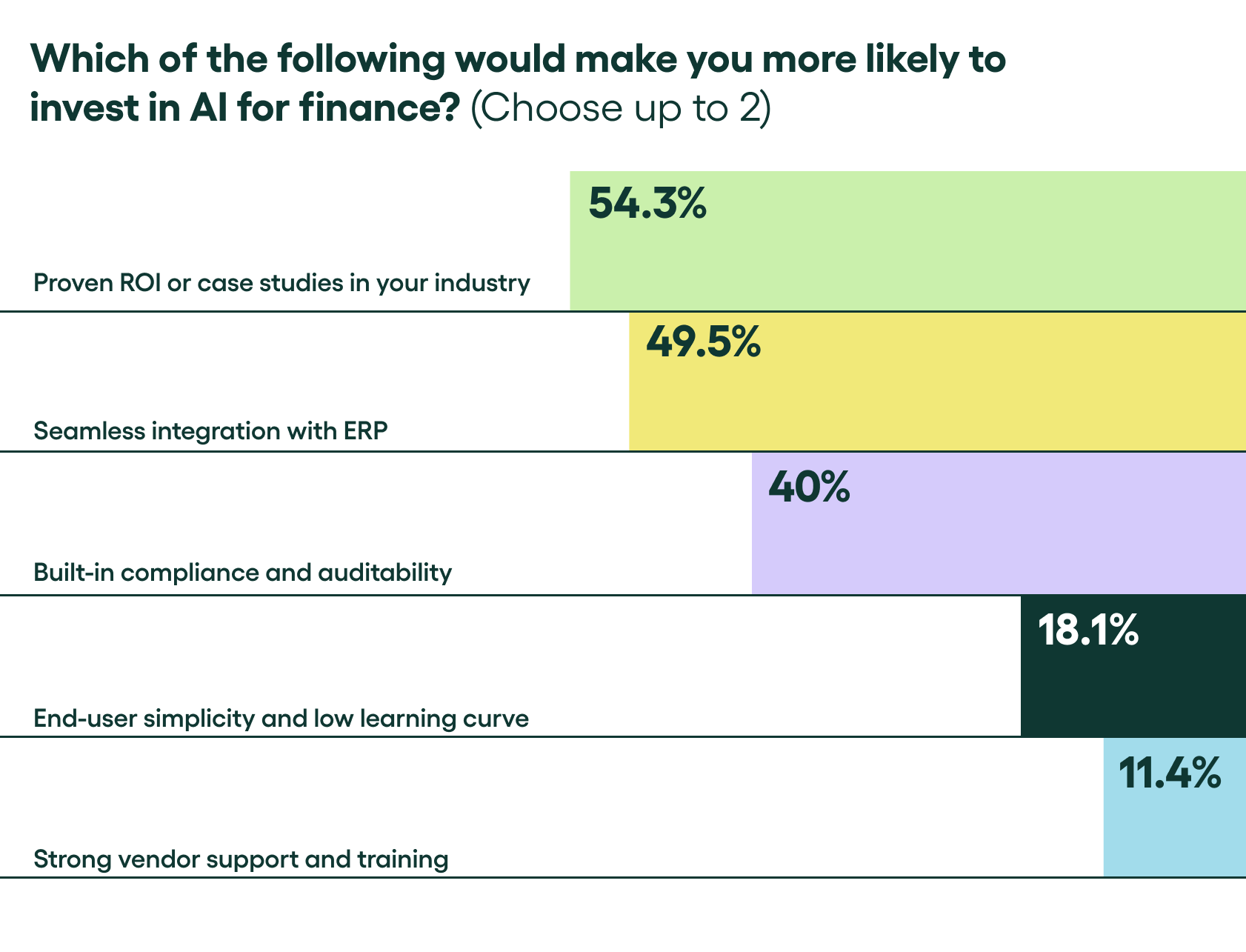
The pattern is easy to understand. CFOs want tools that fit into the systems they already trust and produce results they can measure and stand behind. Proven ROI and ERP integration sit at the top of the list because they reduce both financial risk and implementation friction.
Compliance and auditability ranking third reinforces a theme running throughout the survey: if a tool can’t support governance, it won’t make it far.
Emil Fleron, AI Engineer at Rillion, comments:
“For finance leaders, AI has to prove its value inside the systems they already trust. If the results show up clearly in the ERP, if the audit trails hold up, if the numbers are consistent — that’s when adoption accelerates. It’s not about flashy features. It’s about reliability, transparency, and clear, repeatable outcomes.”
How AI will reshape roles and skills in finance
Finance leaders aren’t only evaluating new tools — they’re already thinking about how their teams will need to work differently as AI becomes part of day-to-day finance.
When asked how roles will shift over the next few years, respondents pointed to a few clear changes:
- 46.7% expect less manual work and more time spent on analysis.
- 39% anticipate growing demand for hybrid finance-tech skills — people who know the process and the tools.
- 8.6% think some roles may be replaced entirely.
- 5.7% believe AI will support existing roles rather than transform them.
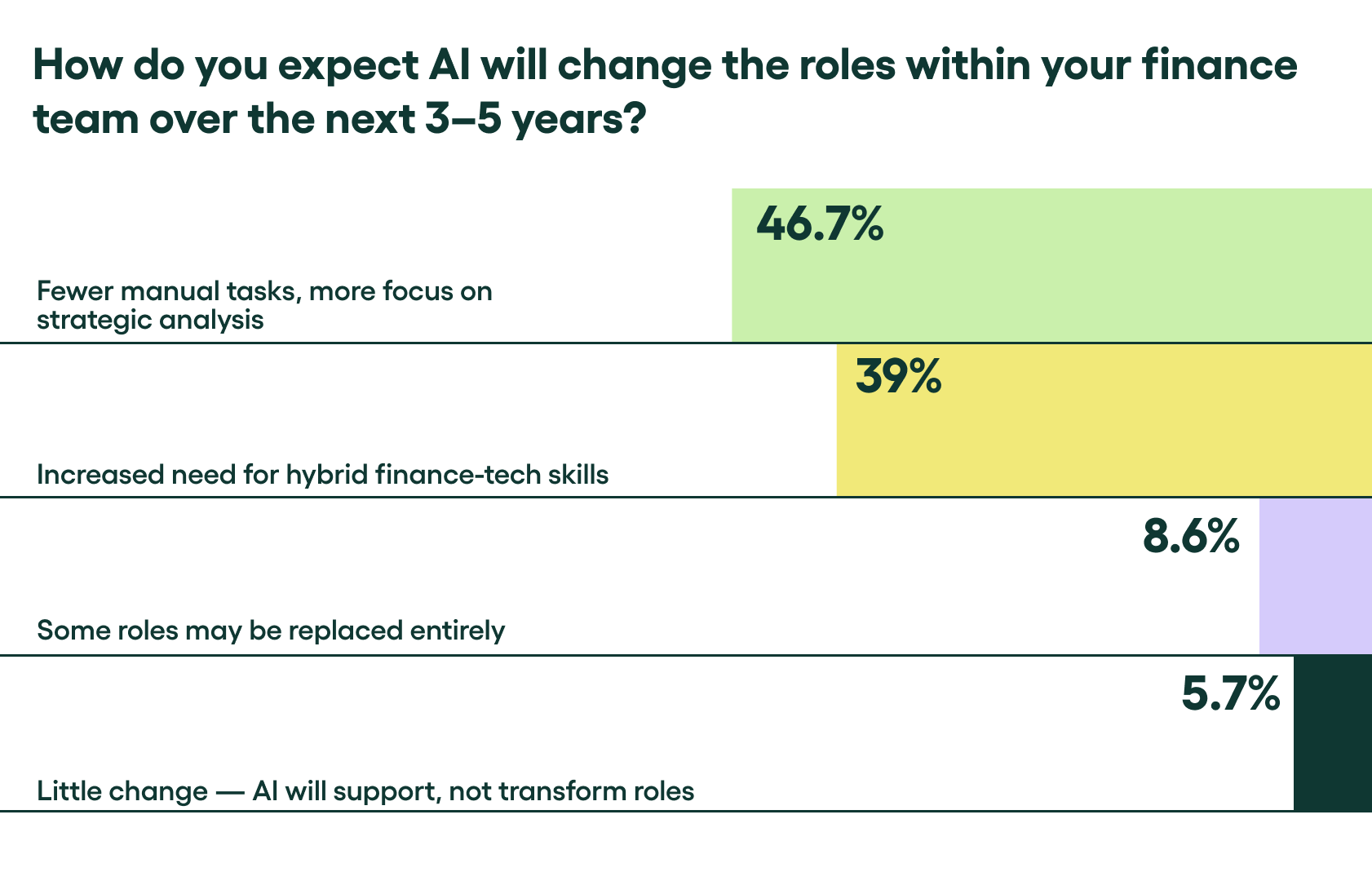
Based on this, it looks like most finance roles aren’t disappearing. They’re shifting toward more analysis and decision-making.
As routine tasks become more automated, finance work shifts toward interpretation, judgment, and strategy. Teams will need to feel comfortable working with AI-generated insights and confident enough to validate, question, and act on them.
It also explains why the next phase of AI adoption depends so much on people, not just software.
What this means for finance teams
Building an AI-ready finance function means strengthening three areas:
- Data confidence: being able to interpret patterns, validate predictions, and challenge outputs when needed.
- Technical literacy: not coding, but understanding how the tools work, where they fit, and what they can and can’t do.
- Change adaptability: adopting new workflows, governance models, and ways of making decisions.
What delays the adoption of AI in finance?
Even with plenty of excitement, several concerns continue to hold teams back:
- Employee resistance to automation (29%)
- Difficulty integrating with existing finance systems (28%)
- Irreversible AI decisions (28%)
- Poor data quality or fragmentation (10%)
- Concerns about long-term vendor lock-in (5%)
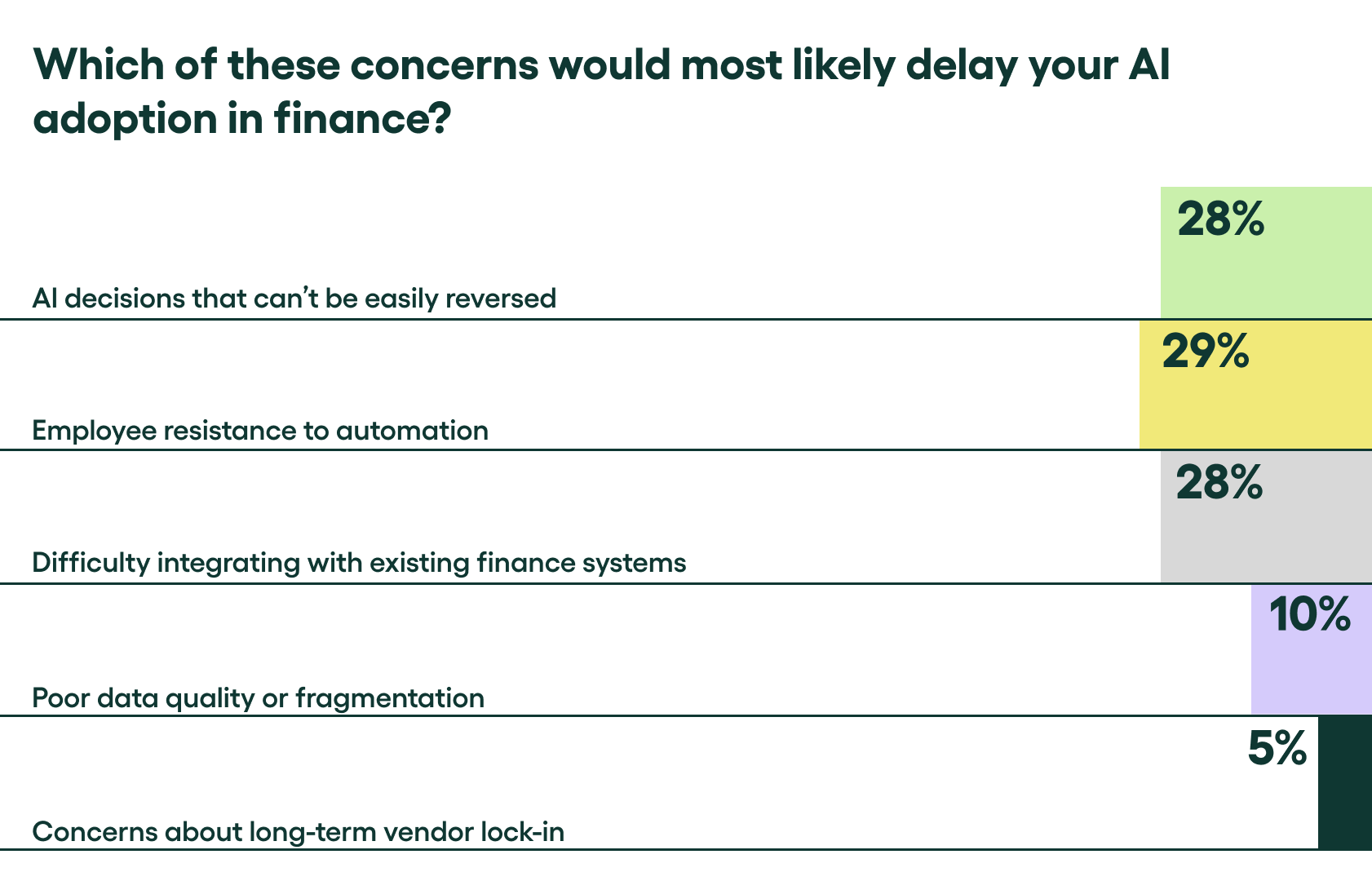
Some of these hurdles are technical, but many are human. If people don’t trust how a recommendation was made — or don’t feel confident they can override it — they’re far less likely to use it.
A big share of the hesitation comes down to reversibility. Finance leaders are wary of tools that make decisions that can’t be adjusted or rolled back easily, especially in workflows tied to compliance or audit.
What finance teams need
For AI tools to get adopted widely, they must offer:
- Clear audit trails
- Transparency into why the AI made a recommendation
- Straightforward ways to reverse or adjust decisions
- Configurable automation thresholds
- Flexible routing for higher-risk scenarios
Integration issues and user resistance also highlight the importance of change management. Teams adopt AI faster when they understand why it’s being used, how it works, and where the guardrails are.
Preparing for the fully AI-enabled finance team
If you look across the responses, finance teams seem to be moving through three stages as they adopt AI.
Wave 1 is the familiar stuff — automating repetitive tasks like capture, coding, routing, and reminders.
Wave 2 is where many teams are heading now: using AI to flag anomalies, surface unusual patterns, and offer predictive insights.
Wave 3 is more aspirational. It includes autonomous optimization and forward-looking forecasting — capabilities that exist today but require stronger governance, cleaner data, and more trust before they can be widely adopted.
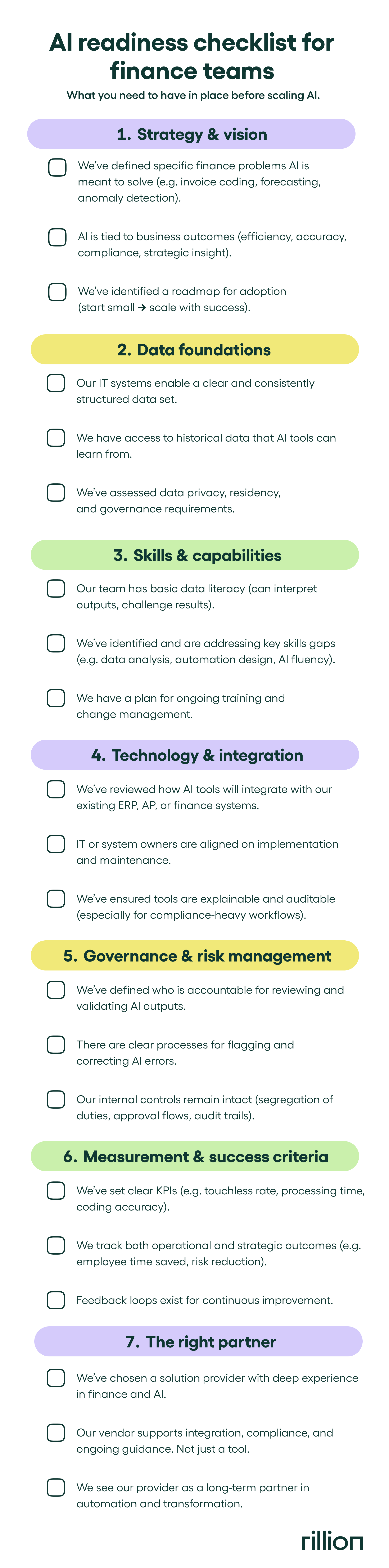
AI readiness checklist for finance teams
To move from early adoption to scaled impact, finance teams need a solid foundation across strategy, data, capabilities, integration, and governance. The checklist below outlines what should be in place before scaling AI:
Conclusion: The future of AI in finance is intelligent, risk-aware, and measurable
The next chapter of AI in finance won’t be defined by full automation. It will be shaped by tools that help teams see issues sooner, understand their data more clearly, and make decisions with more confidence.
Fraud detection, anomaly monitoring, and predictive insights are leading the way because they solve real problems and reduce real risk. And when AI can show its value, integrate smoothly with existing systems, and support the controls finance teams depend on, adoption will follow.
Curious how this plays out inside accounts payable? Book a demo with Rillion and see how intelligent automation can improve accuracy, strengthen control, and speed up your workflows.
What’s The Finance Labs?
The Finance Labs by Rillion is your go-to source for finance automation insights. Each month, we deliver bite-sized reports designed for CFOs and finance leaders, packed with the latest trends in finance and accounts payable automation.
Our insights are backed by real-world data from Rillion’s platform and anonymous surveys of finance leaders across the US and EMEA.