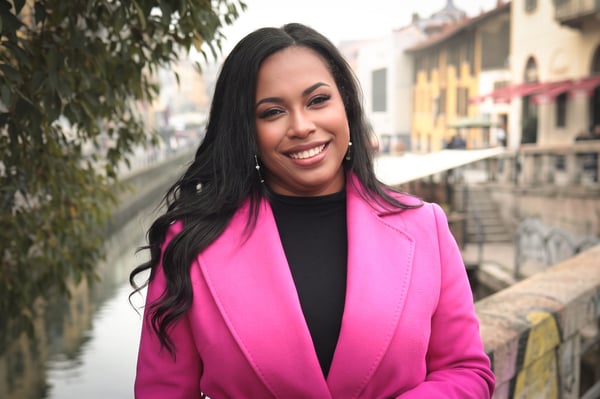

Wassia Kamon, CFO at ACE and named CFO of the Year in 2025, sees AI as a powerful assistant for finance. But when the decisions really matter, there is one thing she won’t delegate: accountability.
In this conversation, she reflects on insights from Rillion’s latest research, The 2026 AI in Finance Report, and shares how she thinks finance leaders can build genuine trust in AI. What happens when AI gets something wrong and a human still has to answer for it? How do you build up what Wassia calls a “trust bank” over time? And why might the best place to start with AI be the tools your finance team already uses every day?
You were named CFO of the Year in 2025. From your position at the top of the finance function, how do you personally think about the role of AI in decisions that actually matter?
I see AI as a tool and an assistant that can (and will) make life easier for finance teams. Ultimately, the responsibility of any output or suggestion from the team is the responsibility of the team, regardless of how it was generated. That’s why it is important to keep a human in the loop for those critical decisions, someone who can effectively communicate with key stakeholders. Someone who can thoughtfully challenge any output generated by AI. Someone who knows what good actually looks like because AI can make something very wrong look very good.
Rillion's data shows that 81% of US finance leaders report moderate or high trust in AI, but fewer than 40% are comfortable letting it do anything beyond low-risk tasks. Does that match your own experience and where do you personally draw the line?
Yes, it matches my experience. So far, we have used AI capabilities that were embedded into the solutions we use every day, like our ERP and AP systems. I draw the line whenever the answer to this question is no: If something goes terribly wrong, will you get away with saying “AI did it” or “It was AI’s fault”?
The more inconsistencies in the output, the less trust. It is almost like a trust bank that grows as more money is deposited by those wins, and money is withdrawn as the output is wrong.
Trust in AI seems to be built gradually through experience. How have you seen that trust develop in your own finance function and what made you extend it further over time?
The more wins, the more trust. For example, when AI is able to flag abnormalities correctly without missing any. When the results provided on a summary can easily be traced to the source document and they tie. On the other hand, the more inconsistencies in the output, the less trust. It is almost like a trust bank that grows as more money is deposited by those wins, and money is withdrawn as the output is wrong.
What has helped us in the process is documenting what the AI model usually gets wrong and what it usually gets right along the way, and how to spot and correct those mistakes.
Our data shows that finance leaders who use AI widely have significantly higher trust in it than those who don’t. Is trust in AI something you build by using it, or do you need a certain level of trust before you are willing to use it at all?
There is definitely a certain level of trust that needs to be there before using it, and that usually depends on what I like to call the rules of AI engagement. One of them is data safety. Is my data safe? Meaning, does the particular tool have the ability to alter, delete or share my actual data on its own. Another one is data accuracy. Is the AI model pulling from different sources of truth for a given variable?
Once those basics are established, I can see more leaders using it more and more. The problem is that oftentimes, the definition of those basics is not established, so people do not even try.
You have a large and engaged following of finance professionals. What do you hear most from your community about where their trust in AI stops, and what would need to change for them to go further?
I don’t hear much about trust in AI. Most are excited to try. The problem is where to start because there are a lot of tools out there and very few successful case studies.
Finance is built on accountability. When AI is involved in a decision that goes wrong, who is responsible? How does that question affect how much trust finance leaders are actually willing to extend?
Humans will always be the ones responsible. That’s why a lot of finance leaders do not feel comfortable signing off on something they do not fully comprehend, or cannot trace “formulas” back as they would in a traditional spreadsheet.
If you could give one piece of advice to a CFO who wants to build genuine trust in AI within their finance function, what would it be?
Start with the tools that you are already using or would be using that have AI capabilities built in.
The interview was first published in Rillion's AI in Finance Report.
About Wassia Kamon
Wassia Kamon is CFO at ACE | Access to Capital for Entrepreneurs and host of The Diary of a CFO podcast. She has more than 15 years of experience in accounting and FP&A across manufacturing, technology, pharmaceuticals, and the nonprofit sector, and was named CFO of the Year by the Atlanta Business Chronicle in 2025.