
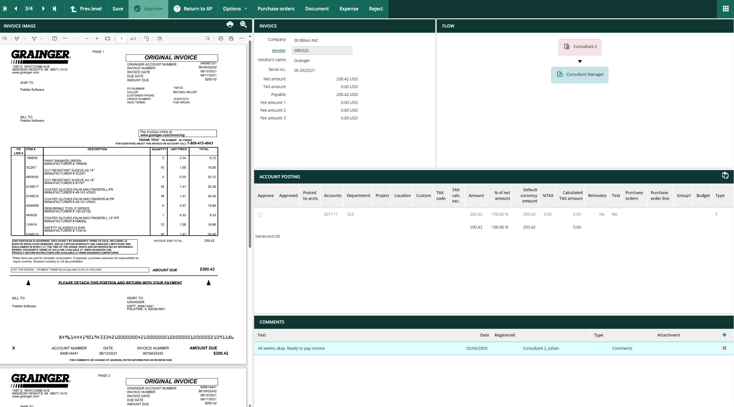
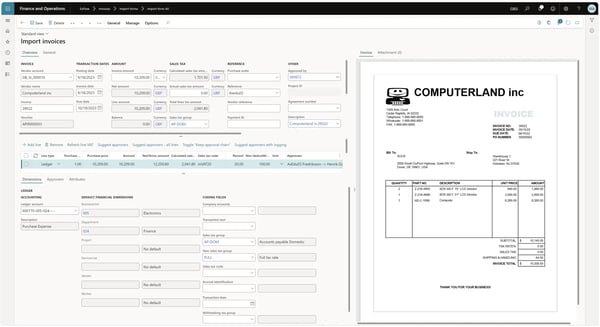
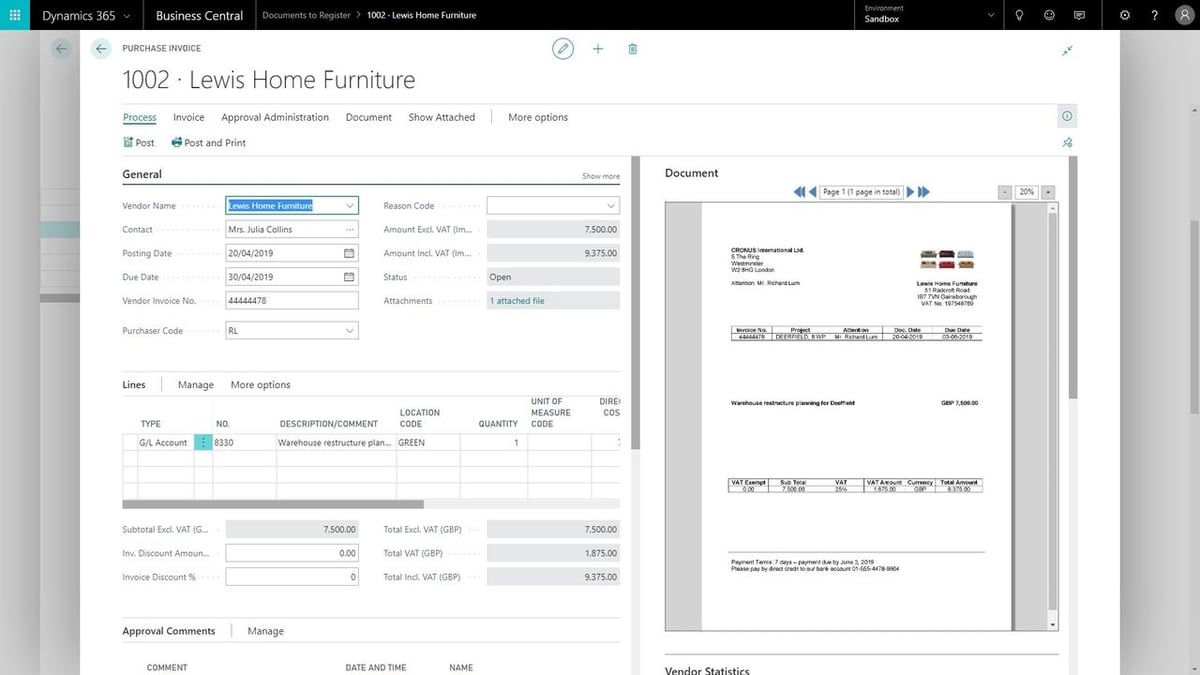
One of Continia's biggest strengths is also one of its biggest limitations: it's built specifically for Microsoft Dynamics 365 Business Central.
That tight integration creates a seamless experience for many finance teams. But it can also narrow your options if your technology stack evolves, your processes become more complex, or you need capabilities that extend beyond AP automation.
Whether you're looking for stronger payment automation, more flexible integrations, deeper spend controls, or additional supplier management features, there are plenty of alternatives worth considering.
Here are the best 10 Continia alternatives for you to consider:
-
Rillion — Flexible, AI-powered AP automation across 50+ ERPs
-
Stampli — People-first AP automation
-
Yooz — Lean financial ops for growing businesses
-
Medius — Effective AI-driven AP automation
-
MineralTree — Invoice-to-pay system for mid-market businesses
-
Tipalti — Centralized, global payments system
-
Coupa — Unified procurement and expense control
-
AvidXchange — AP automation with a built-in supplier payment network
Compare Continia alternatives
Here’s a quick look at the best Continia alternatives, who they fit, and what makes them stand out:
| Competitor | Why it’s a good Continia alternative | Best for | Stand-out feature |
| Rillion |
Delivers AI-powered AP automation, built-in multi-entity management, and support for 50+ ERPs, giving finance teams more flexibility as they scale.
|
|
AI-native invoice capture |
| Stampli |
Unlike Continia, Stampli builds conversations, approvals, and supporting documents directly into the invoice workflow, reducing back-and-forth and speeding resolution. |
|
Billy the Bot™ |
| Yooz |
Yooz combines AP automation with a Lean Financial Operations™ framework designed to help finance teams scale without adding headcount. |
|
Lean Financial Operations™ |
| Medius |
Applies AI beyond invoice processing to reduce supplier inquiries, approver questions, and other administrative work that can slow AP teams down. |
|
Touchless invoice processing |
| MineralTree |
Goes beyond bank-connected payment workflows by executing vendor payments directly and creating rebate opportunities through virtual card payments.
|
|
TotalPay |
| Tipalti |
Combines supplier onboarding, tax compliance, global payments, and AP automation in a single platform for international operations. |
|
Global payments infrastructure |
| Coupa |
Extends beyond AP automation into procurement, supplier management, contracts, and spend control, providing visibility across the entire spend lifecycle.
|
|
Coupa AI |
| AvidXchange |
Takes a more supplier-centric approach to payments, giving vendors self-service tools that reduce payment-related back-and-forth for AP teams. |
|
AvidPay Network |
1. Rillion
Flexible, AI-powered AP automation across 50+ ERPs
While Continia is built specifically for Microsoft Dynamics 365 Business Central, Rillion takes a more flexible approach to AP automation.
It helps finance teams capture invoices, automate approvals, streamline payments, and reconcile those payments while integrating with more than 50 ERP systems, including Microsoft Dynamics 365 BC, NetSuite, Sage Intacct, SAP Business One, and many others.
The platform includes all the traditional features of an AP automation solution, with AI applied where it makes a real difference:
-
AI invoice capture that extracts data across invoice formats with over 95% accuracy and suggests correct general ledger codes based on past patterns.
-
Automated approval workflows that can be configured using custom rules or AI-driven suggestions.
-
3-way purchase order matching for greater accuracy and compliance.
-
Payment automation including secure virtual cards and automated reconciliation.
-
Advanced reporting and analytics for spend visibility across entities.
Where Continia's strength lies in its native Business Central experience, Rillion focuses on giving finance teams more flexibility, deeper AI capabilities, and the freedom to automate AP without being tied to a single ERP.
Other key features in the Rillion platform include:
-
Multi-entity management: Approve invoices, manage spend, and gain real-time visibility across multiple companies or locations from one screen. Ideal for organizations that need centralized oversight across subsidiaries or business units.
-
Riley, the AI Assistant: Ask the built-in AI questions about invoices, suppliers, or workflows and get instant answers. Riley helps users resolve issues quickly and stay productive without delaying AP tasks.
-
Role-based approval workflows: Assign permissions based on roles to improve security, compliance, and efficiency. Approvers receive automated reminders and can review invoices from desktop or mobile devices.
-
Virtual card payments with rebates: Securely pay vendors using virtual cards, reducing fraud risk while creating rebate opportunities that can offset AP costs.
Why Rillion is a good Continia alternative
Rillion and Continia both help finance teams automate accounts payable, but they approach the challenge differently.
Continia focuses on delivering a native experience within Microsoft Dynamics 365 Business Central. Rillion focuses on making AP as automated, scalable, and hands-off as possible, regardless of which ERP an organization uses.
That focus is reflected in how AI is applied throughout the AP process. Beyond invoice capture, Rillion's AI helps predict coding, suggest approval routes, and reduce the manual effort required to keep invoices moving through complex workflows.
Riley, the platform's built-in AI assistant, also gives users instant answers about invoices, suppliers, and workflows, helping teams resolve questions without interrupting their work.
And where Continia relies on an additional extension for multi-entity management, Rillion builds those capabilities directly into the platform. Finance leaders get centralized visibility across companies and locations, making it easier to scale AP operations without sacrificing control.
What to be aware of
Rillion doesn't currently offer a dedicated mobile app for managing the full AP process. Approvers can still review and approve invoices from their phones, but finance teams that rely heavily on mobile workflows may find some functionality better suited to desktop use.
Standout feature – AI-native invoice capture
Invoice capture is one area where Rillion stands out. The AI extracts data from PDFs, scans, and emails with roughly 95% accuracy from the first invoice, then suggests the correct GL code based on how your team has coded similar invoices in the past.
While many platforms bolt AI onto existing capture workflows, Rillion's model is built to understand the context of the invoice and doesn't rely on templates and fixed field positions. Combined with customizable rules, finance teams can fine-tune exactly how invoice information should be captured for their specific processes, rather than working within a fixed, one-size-fits-all model.
That means fewer invoices need manual review, and the accuracy of data extraction keeps improving the longer you use it.
Who is Rillion built for?
Rillion is best suited to mid-market companies processing 10,000+ invoices annually, particularly in industries like healthcare, manufacturing, and hospitality. It’s especially valuable for organizations with multiple entities or subsidiaries that need consolidated visibility and streamlined workflows.
Rillion is for finance leaders who want to:
-
Cut invoice processing and approval time with AI-driven automation, going 85% faster
-
Centralize AP across multiple entities for better control and reporting
-
Reduce fraud risk and payment errors with secure, automated vendor payments
-
Eliminate manual double entry through seamless ERP integration (with 50+ leading ERPs)
-
Give AP teams peace of mind with intuitive, user-friendly software
-
Work with a trusted partner to implement AI across their finance processes, confidently and securely
2. Stampli
People-first AP automation
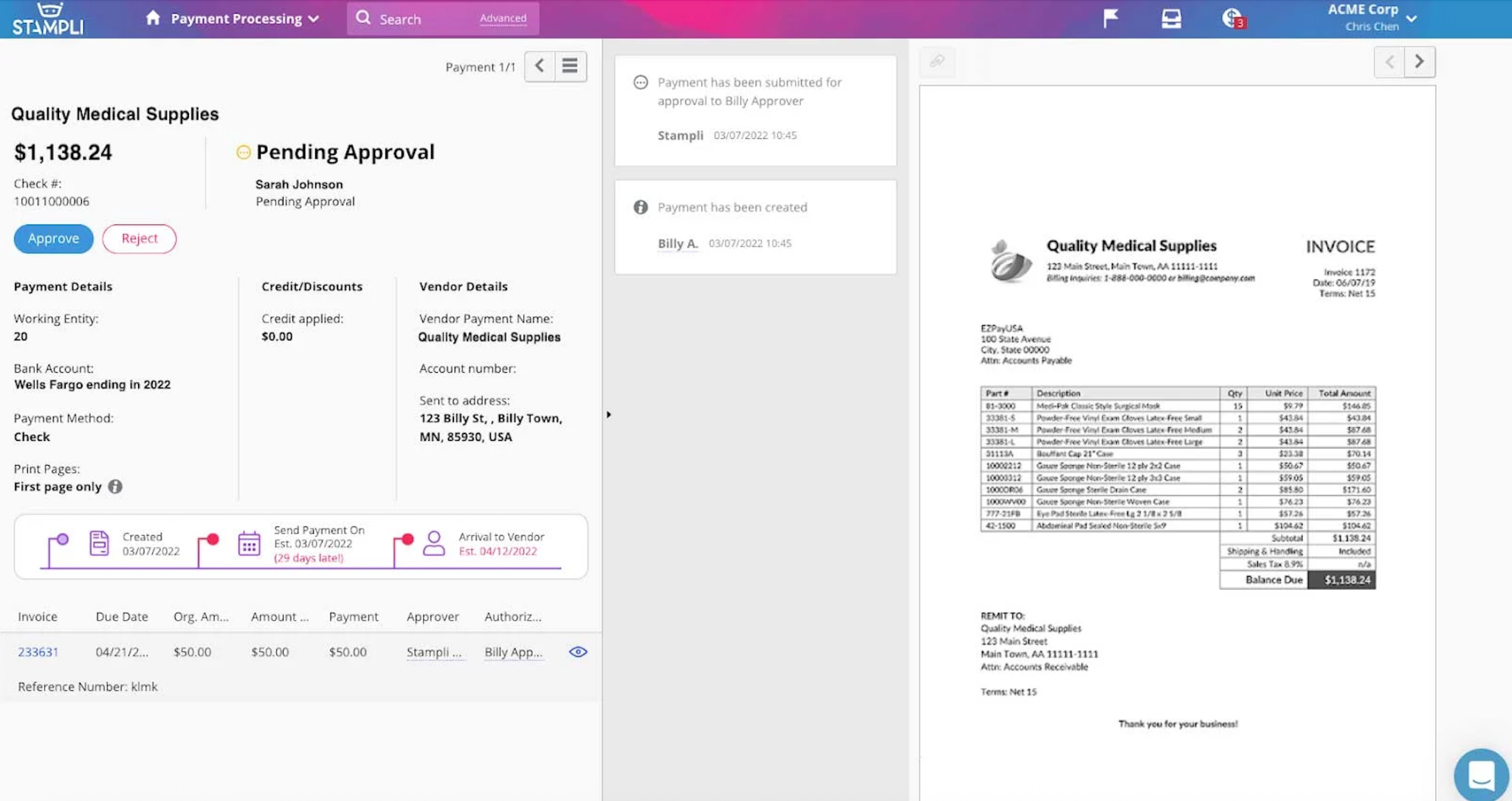
Both Stampli and Continia automate invoice capture, approvals, and other core AP workflows. The difference is that Stampli places much greater emphasis on the people involved in those processes.
Instead of treating communication as something that happens outside the AP system, Stampli builds it directly into the invoice workflow. Conversations, questions, approvals, and supporting documents all stay attached to the invoice itself, reducing the need for email chains and helping teams resolve issues faster.
With strong ERP integrations and an intuitive interface, the platform is designed to be adopted across the organization, not just by the AP team.
Stampli's features include:
-
AI-powered invoice capture & coding: Their AI, Billy the Bot™ extracts invoice data, learns your GL accounts, and applies coding automatically to reduce manual entry.
-
Collaboration built-in: Comments, questions, approvals, and supporting documents stay attached to the invoice itself, creating a centralized audit trail and reducing back-and-forth communication.
-
Custom approval workflows: Routes invoices based on factors like amount, department, or project, with reminders and escalations to keep approvals moving.
-
Two-way ERP integrations: Pre-built, two-way integrations with NetSuite, Sage Intacct, QuickBooks, Microsoft Dynamics, and other leading ERP systems keep financial data synchronized.
-
Vendor management: Suppliers can onboard themselves, upload documents, and track invoice statuses through a self-service portal.
-
Payments & cards: Stampli Direct Pay and Stampli Cards allow organizations to manage vendor payments and employee spend from the same platform.
-
Real-time insights: Dashboards and customizable reports provide visibility into spend, approvals, invoice status, and overall AP performance.
Why Stampli is a good Continia alternative
Continia focuses on streamlining AP processes within the ERP. Stampli focuses on removing the communication bottlenecks that often slow those processes down, while integrating with a wide range of leading ERP systems.
Because it centralizes invoice-related conversations and approvals in one place, the platform helps teams spend less time chasing information and more time moving invoices forward.
For organizations where invoice delays are often caused by communication and coordination rather than processing itself, Stampli can be a particularly compelling alternative.
What to be aware of
Stampli prioritizes simplicity and ease of use, but that can come with some tradeoffs for organizations with highly specific workflow requirements.
Some users report limitations when creating highly customized reports or configuring more complex approval scenarios, making the platform a better fit for teams that value simplicity over extensive customization.
Standout feature – Billy the Bot™
Billy the Bot™ is Stampli's AI co-pilot for AP. Billy learns your organization's invoice patterns over time, including how invoices are coded, who typically approves them, and what exceptions should be flagged for review.
It automatically applies coding suggestions, spots potential duplicates, nudges approvers, and helps keep invoices moving through the approval process. The more invoices Billy processes, the smarter it becomes, helping reduce manual effort and accelerating approvals.
3. Yooz
Lean financial ops for growing businesses
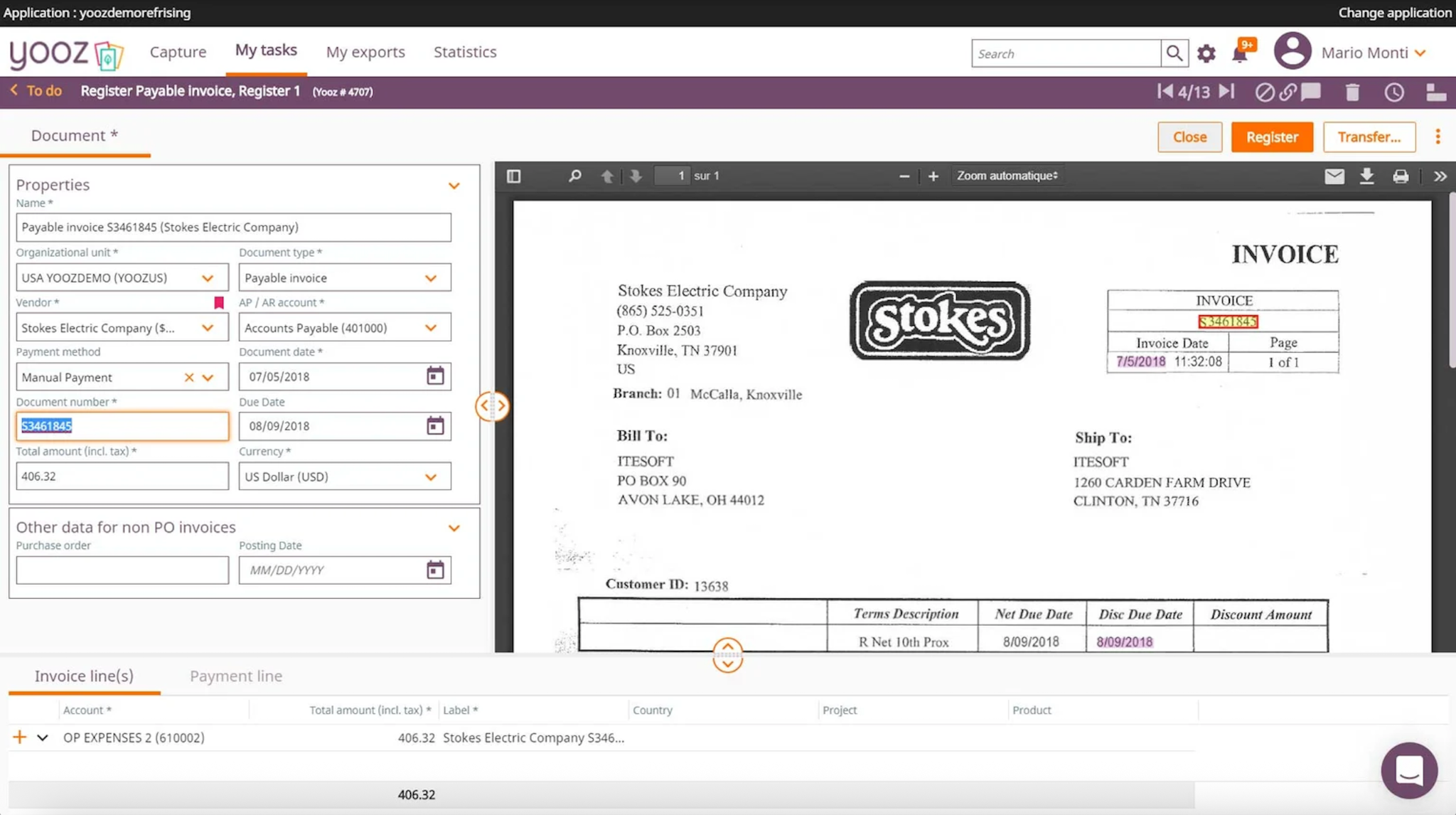
Yooz is an AP automation and procure-to-pay platform designed for mid-sized and fast-growing companies.
It centers its offering around Lean Financial Operations™, a framework designed to help finance teams process more work without adding headcount.
The platform supports the entire AP lifecycle, from invoice capture and approval routing to payments, reconciliation, and reporting. Along the way, it uses AI to extract, code, and validate invoice data, while helping organizations detect potential fraud and automate key AP workflows.
Yooz is also known for its deployment flexibility. While Continia is built specifically for Business Central, Yooz integrates with more than 250 ERP systems, including QuickBooks, NetSuite, Sage, Microsoft Dynamics, Acumatica, and several industry-specific platforms.
Yooz's features include:
-
Omnichannel invoice capture: Accepts invoices via email, portal, EDI, or mobile, applying AI to extract, code, and validate data in real time.
-
Fraud protection: AI-powered tools for fake invoice detection, atypical amount alerts, IBAN verification, and secure user authentication.
-
Dynamic workflows & routing: Configurable rules for requisitioning, PO matching, approvals, and exception handling, adaptable to different business requirements.
-
Automated payments: Supports ACH payments, virtual cards with cashback opportunities, and vendor statement reconciliation for end-to-end payment automation.
-
Analytics & reporting: Real-time dashboards, audit trails, and budget tracking tools help improve visibility, compliance, and financial oversight.
-
ERP integrations: Connects with more than 250 ERP systems, including Dynamics, QuickBooks, NetSuite, Sage, Acumatica, and industry-specific platforms used in sectors like automotive, trucking, and construction.
Why Yooz is a good Continia alternative
Both Yooz and Continia are strong options for small and mid-sized businesses looking to automate accounts payable. The difference, beyond integrations, is that Yooz places greater emphasis on operational efficiency through its Lean Financial Operations™ framework.
For teams looking to get more done without adding headcount, that translates into fewer manual touchpoints, stronger fraud controls, and more efficient invoice processing across the AP workflow.
What to be aware of
While Yooz is known for its broad integration ecosystem, some users report occasional integration challenges that require additional support to resolve.
Reviews also note that Yooz's OCR technology doesn't always recognize vendor information or invoice amounts correctly, which can create manual rework in certain situations.
Standout feature – Lean Financial Operations™
Yooz's defining feature is its Lean Financial Operations™ framework.
The framework layers fraud detection, payment automation, and flexible approval workflows into a single operating model. Through this, finance teams can spend less time on manual processing, reduce the risk of payment errors and fraud, and handle growing invoice volumes without needing to add staff.
4. Medius
Effective AI-driven AP automation
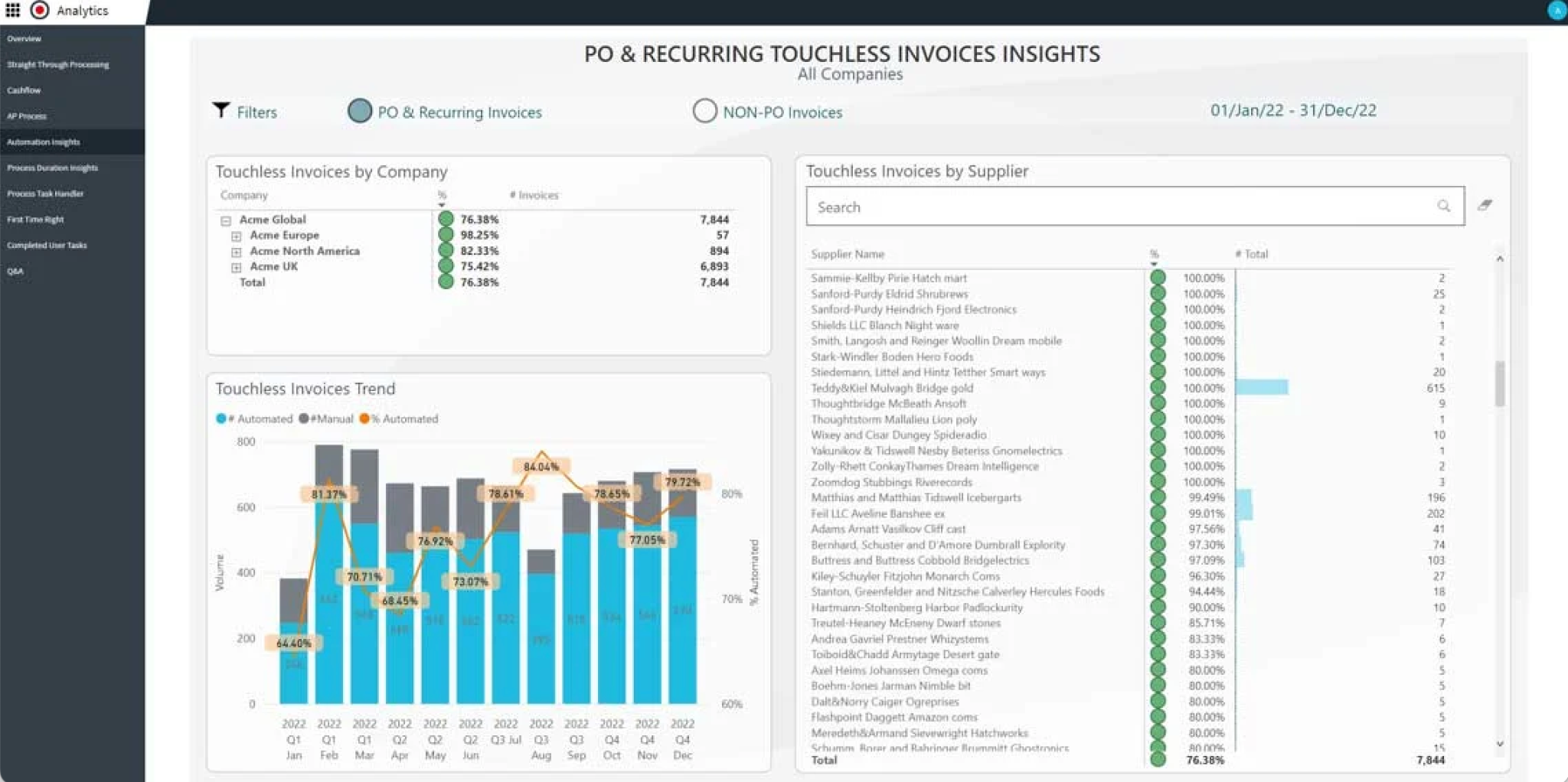
Medius is an AP automation platform designed to help finance teams process invoices with as little manual intervention as possible.
It extends automation into areas that often remain time-consuming through two AI-powered tools: Medius Copilot, which provides contextual answers to approvers, and Supplier Conversations, which automatically handles routine supplier questions about invoices and payments.
While Continia automates many of the core AP processes, Medius goes a step further by helping automate the conversations that often slow those processes down.
Medius's key features include:
-
AI invoice capture & touchless processing: Extracts and validates invoice data, applies coding, and matches invoices against purchase orders and receipts with minimal manual intervention.
-
Workflow automation: Customizable rules for routing, approvals, and exception handling help invoices move through the process quickly while maintaining compliance.
-
Payments & fraud detection: Built-in payment automation combined with fraud and anomaly detection helps reduce the risk of duplicate or irregular payments.
-
ERP connectors: Pre-built integrations with SAP, Microsoft Dynamics, NetSuite, Oracle, Infor, and other ERP systems reduce implementation complexity and accelerate time to value.
-
Analytics & spend visibility: Real-time dashboards and KPIs highlight liabilities, cycle times, and bottlenecks, giving finance leaders a clearer view of AP performance.
-
AI assistants: Medius Copilot helps approvers find answers faster, while Supplier Conversations automatically responds to common supplier questions about invoice and payment status.
-
Global compliance support: Supports multiple currencies and evolving e-invoicing and tax requirements, making it easier to manage AP across international operations.
Why Medius is a good Continia alternative
Both platforms automate core AP processes, but Medius is designed for organizations that need to scale those processes across larger and more complex operations.
Unlike Continia, Medius applies AI to some of the administrative work that surrounds AP. Medius Copilot helps approvers find answers faster, while Supplier Conversations automatically handles routine questions about invoice and payment status.
Fewer supplier emails, fewer status requests, and fewer interruptions mean AP teams can spend more time managing exceptions and less time tracking down information. That can be especially valuable for growing mid-market and enterprise organizations processing large volumes of invoices.
What to be aware of
Medius offers extensive functionality, but some users report that customizing certain features can be less intuitive than expected, requiring additional time to configure the platform to their needs.
Others also note that building reports can feel overly technical and less user-friendly than they would like, which may add friction for teams that frequently create and customize reports for operational or financial analysis.
Standout feature – Touchless invoice processing
Medius uses AI to extract invoice data, validate information, apply coding, match invoices against purchase orders and receipts, and route invoices through approval workflows with minimal human intervention.
While Continia automates many of these same processes, Medius pairs its touchless processing capabilities with AI-powered support tools like Copilot and Supplier Conversations, cutting down both the operational work and the communication overhead that often surrounds invoice processing.
5. MineralTree
Invoice-to-pay system for mid-market businesses
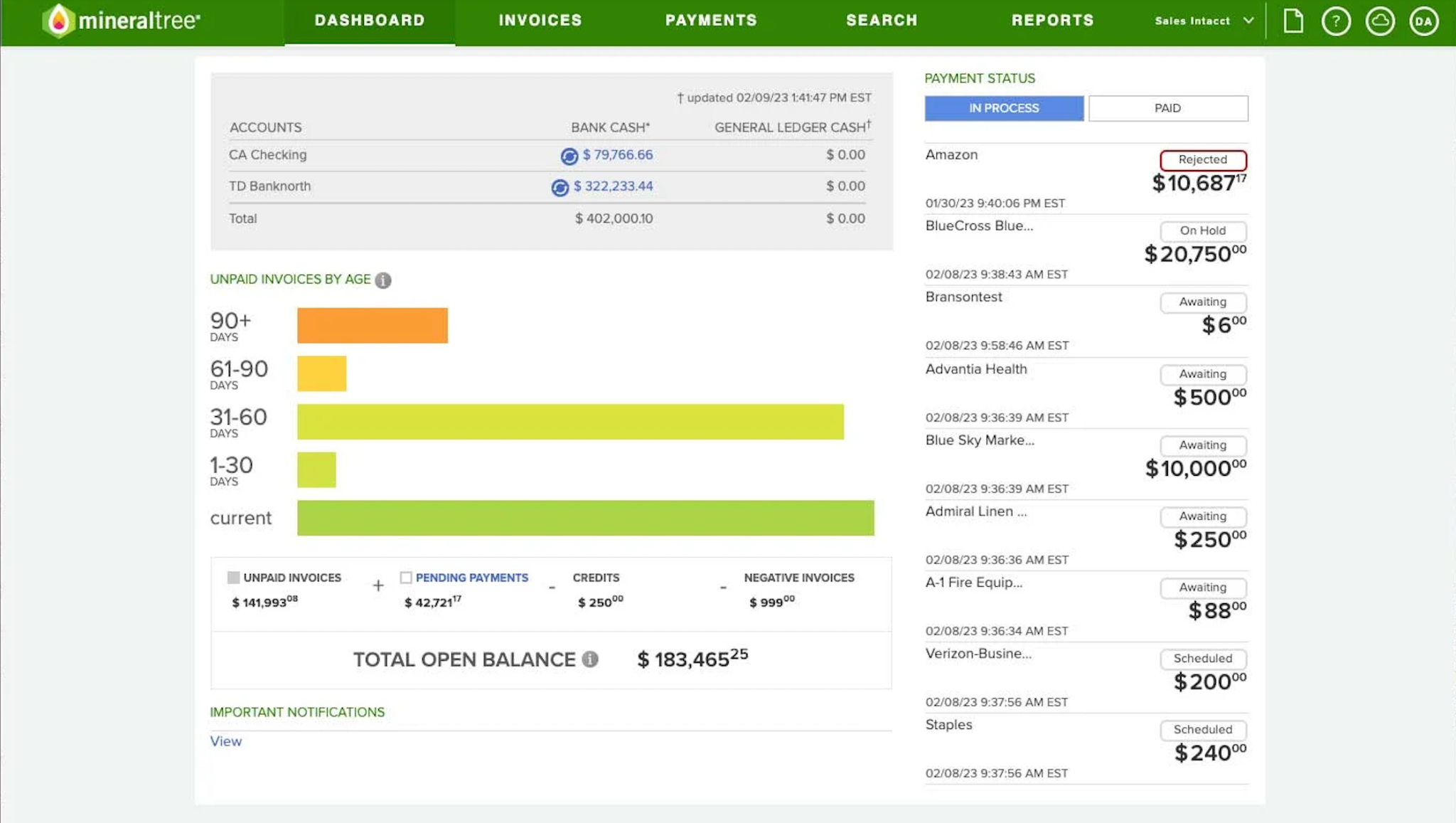
MineralTree is an AP automation and payments platform designed for mid-market organizations that want to modernize the entire invoice-to-pay process.
In addition to capturing invoices and automating approvals, it helps finance teams execute vendor payments through multiple payment methods from the same platform.
Where Continia only streamlines the movement of payment data between your ERP and your bank, MineralTree initiates ACH, check, and virtual card payments directly through its own network rather than just handing off files for your bank to process.
MineralTree's key features include:
-
Invoice capture & workflows: OCR and machine learning extract invoice data, apply GL codes, and route invoices through approval workflows with automated reminders and escalations.
-
Payment execution (TotalPay): Pay vendors via ACH, check, wire transfer, virtual card, or foreign currency payments from a single platform.
-
ERP integrations: Syncs with Microsoft Dynamics, NetSuite, QuickBooks, Sage Intacct, and other leading ERP systems.
-
Fraud controls: Role-based permissions, dual approvals, audit trails, and two-factor authentication reduce payment risk and strengthen internal controls.
-
Analytics & dashboards: Tracks invoice cycle times, payment activity, working capital outflows, and virtual card rebate performance.
Why MineralTree is a good Continia alternative
Like Continia, MineralTree helps finance teams automate invoice capture, approvals, and payments. The difference is that MineralTree takes a more active role in payment execution.
Through TotalPay, MineralTree's integrated payment engine, organizations can manage vendor payments across multiple payment methods from a single platform rather than relying on payments being routed through connected banks, as they are with Continia.
MineralTree also creates opportunities to generate virtual card rebates through TotalPay, turning vendor payments into a potential source of cost savings.
It's also worth checking MineralTree's Business Central integration status directly with them. Unlike Continia, which is a certified, Microsoft-listed extension, MineralTree's Business Central connector doesn't currently appear on Microsoft's AppSource marketplace.
What to be aware of
Some users mention occasional lag when processing invoices. For organizations that process large volumes of invoices or depend on real-time visibility, those delays may be worth evaluating before making a decision.
Others also report syncing issues between MineralTree and their accounting system, which can result in manual investigation when invoices, payments, or account data don't transfer as expected.
Standout feature – TotalPay
For many organizations, the most valuable part of MineralTree is TotalPay.
Not only does it give organizations flexibility in how they pay vendors through ACH, checks, wires, and virtual cards, it also helps optimize those payments.
The platform identifies vendors that can accept virtual cards and routes payments accordingly, creating rebate opportunities while still giving suppliers flexibility in how they get paid.
It's a simple idea, but one that can turn a routine AP process into a source of meaningful cost savings.
6. Tipalti
Centralized, global payments system
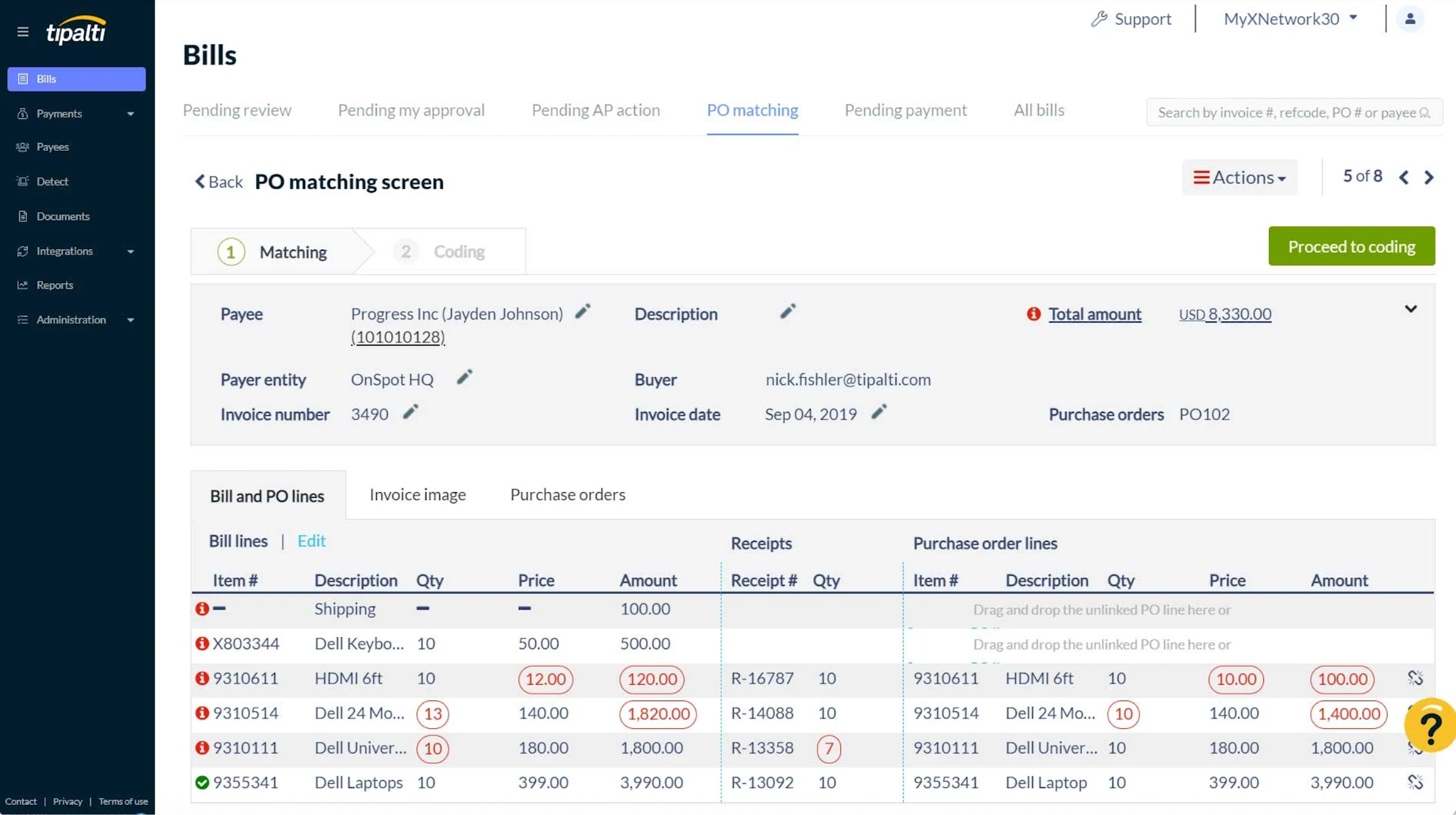
Tipalti is an AP automation platform designed for organizations managing large numbers of suppliers across multiple countries, currencies, and entities.
Its biggest difference from Continia lies in scope.
While Continia hands off payment data for your bank to execute, Tipalti owns the entire process itself, onboarding suppliers, validating their tax forms, converting currencies, and paying them directly in 120+ currencies and local payment methods, all without involving a separate bank step.
That makes it particularly well suited to growing and enterprise organizations with international operations.
Tipalti's key features include:
-
Global mass payments: Send payments to suppliers in 200+ countries and territories, across 120+ currencies, using multiple payment methods.
-
Invoice processing automation: OCR-based invoice capture, 2-way and 3-way matching, and approval workflows help reduce manual AP work.
-
Supplier self-service portal: Vendors can onboard themselves, submit tax and banking information, and track payment status without contacting your AP team.
-
Tax & compliance automation: Collects and validates W-8 and W-9 forms, applies tax rules, and supports year-end reporting requirements.
-
Multi-entity and multi-currency management: Manage subsidiaries, currencies, and payment operations through a centralized platform.
-
Fraud & risk controls: Built-in validation, sanctions screening, and audit trails help strengthen compliance and reduce payment risk.
-
ERP & accounting integrations: Connects with major ERP and accounting systems to keep invoice, supplier, and payment data synchronized.
Why Tipalti is a good Continia alternative
The biggest advantage of Tipalti is that it brings several processes that are often managed separately into a single workflow.
Beyond invoice processing, supplier onboarding, tax collection, compliance, and payments all happen within the same system, reducing the number of handoffs required to move suppliers from onboarding to payment.
As organizations grow, that centralized approach can make it easier to maintain consistency across entities while reducing the administrative burden on finance teams.
What to be aware of
While Tipalti's payments and compliance capabilities are highly regarded, some users report limitations in areas of the AP workflow itself.
Reviews mention that OCR accuracy can occasionally require manual correction, particularly when processing invoices in foreign languages. Others note that reporting can be complicated, sometimes requiring multiple reports to answer a single question.
Organizations will need to weigh these limitations against Tipalti's strengths in global payments, supplier management, and compliance when evaluating whether the platform is the right fit.
Standout feature – Global payments
What sets Tipalti apart is the scale at which it can operate, all thanks to its global payments infrastructure.
It supports payments in 120+ currencies across more than 200 countries and territories and multiple payment methods, including ACH, wire transfer, Global ACH (eCheck), PayPal, live paper check, and more.
The platform also handles currency conversion, tax requirements, and compliance checks behind the scenes. For organizations managing large supplier networks across multiple regions, that makes it much easier to execute high volumes of payments accurately and efficiently.
7. Coupa
Unified procurement and expense control
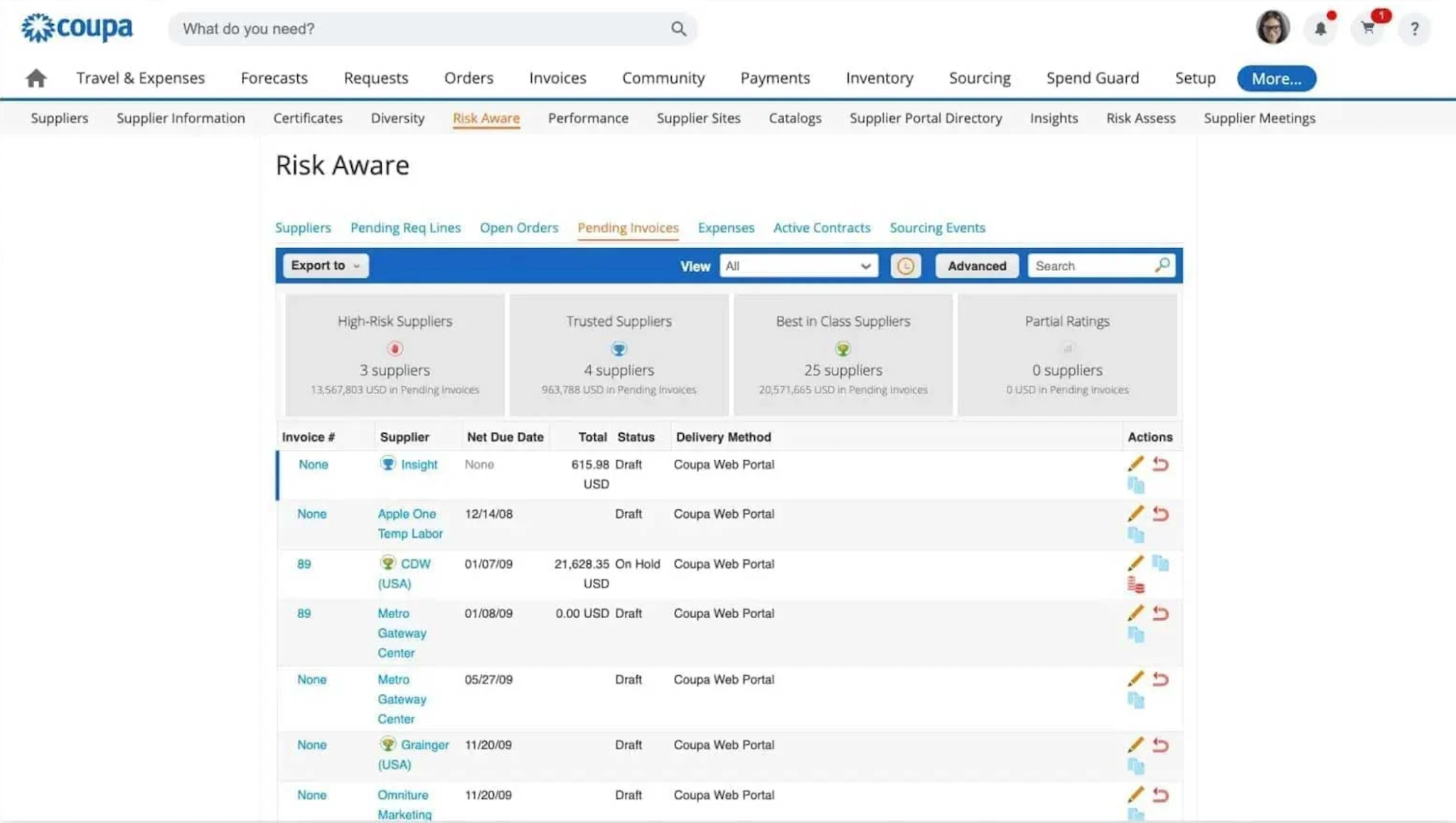
Coupa is an AI-driven spend management platform used by organizations that want greater visibility and control over how money is spent across the business.
The platform brings procurement, supplier management, expenses, invoicing, payments, and contracts together in one place, helping teams improve budget control and gain real-time visibility into company-wide spend.
While Continia focuses on streamlining invoice processing and payments, Coupa helps organizations manage the entire spend lifecycle — AP automation and beyond.
That broader scope makes it a popular choice among CFOs and procurement leaders looking to control costs and standardize purchasing across multiple departments, locations, or subsidiaries.
Coupa's key features include:
-
Procure-to-pay automation: Digitizes the full requisition, purchase order, invoice, and payment process to reduce manual work and improve compliance.
-
Supplier management: Onboard, track, and evaluate suppliers through centralized profiles, performance metrics, and compliance controls.
-
Guided buying: Direct employees toward approved suppliers, preferred products, and negotiated pricing to reduce off-contract spending.
-
Spend analytics & dashboards: Provides real-time visibility into budgets, spending patterns, supplier performance, and purchasing activity.
-
Contract lifecycle management: Automates contract creation, approval, renewal, and compliance monitoring while helping teams identify potential risks.
-
AI-powered insights: Uses anonymized community spending data to surface savings opportunities, supplier risks, and purchasing recommendations.
-
Mobile approvals: Review and approve requisitions, invoices, expenses, and other spending requests from any device.
Why Coupa is a good Continia alternative
Continia focuses on automating AP processes after a purchase has already been made. Coupa extends much further upstream, helping organizations manage procurement, supplier relationships, contracts, expenses, and purchasing decisions before invoices ever reach the AP team.
This visibility helps organizations enforce purchasing policies, reduce off-contract spending, and gain a clearer understanding of where money is being spent across the business.
For larger organizations with complex purchasing processes, those capabilities can be just as valuable as AP automation itself.
What to be aware of
Like many enterprise solutions, some users report that Coupa's interface can feel overly complex and cumbersome to navigate. As a result, it may take longer for employees and suppliers to become comfortable with the platform, which can make adoption more challenging.
Standout feature – Coupa AI
Coupa AI is powered by trillions of dollars in anonymized spending data from millions of buyers across its network.
Instead of relying solely on an organization's own purchasing history, it uses insights from that broader dataset to identify supplier risks, surface savings opportunities, and recommend smarter purchasing decisions.
Access to that collective intelligence helps enterprises move beyond processing transactions and toward actively improving profitability, efficiency, and resilience.
8. AvidXchange
AP automation with a built-in supplier payment network
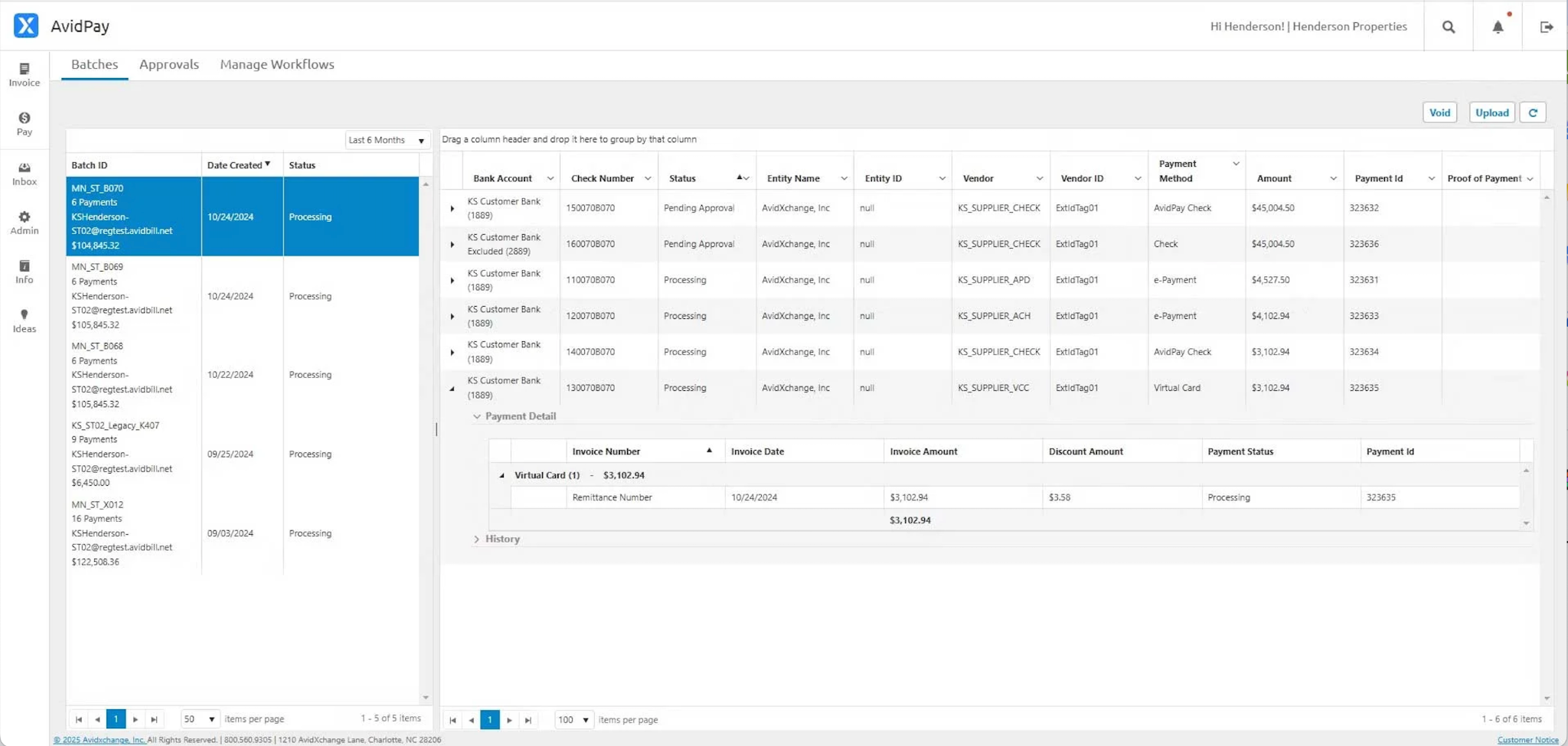
Continia helps finance teams automate invoice processing and route payments through their banking infrastructure. AvidXchange takes a more connected approach, bringing suppliers into the process through its AvidPay Network.
Suppliers can check payment status and choose or update their preferred payment method without having to contact the AP team.
Invoice capture, approvals, and payments are still core parts of the platform. The added supplier visibility simply removes much of the back-and-forth that often surrounds the payment process.
AvidXchange's key features include:
-
Invoice capture & workflow automation: Digitizes invoice capture, coding, routing, approvals, and matching to reduce manual processing.
-
AvidPay Network: Enables suppliers to receive payments electronically, track payment status, and manage payment preferences through a self-service portal.
-
Flexible payment options: Supports ACH, virtual card, and check payments, allowing suppliers to choose how they get paid.
-
Supplier payment visibility: Gives suppliers greater transparency into payment status, helping reduce payment inquiries and administrative work for AP teams.
-
Audit-ready recordkeeping & reporting: Provides visibility into invoice and payment activity through dashboards, reporting tools, and audit-ready records.
-
ERP & accounting integrations: Connects with a wide range of accounting and ERP systems to streamline AP and payment workflows.
Why AvidXchange is a good Continia alternative
One of AvidXchange's biggest advantages is the way it streamlines supplier payments.
The AvidPay Network gives suppliers direct access to payment information and payment preferences, reducing the volume of payment-related inquiries that AP teams need to manage. As supplier counts grow, those time savings can become increasingly valuable.
This model has proven particularly effective for mid-market organizations, especially in industries where recurring payments and large supplier networks are common.
What to be aware of
Some users report that handling exceptions or non-standard invoices can feel less flexible than expected, and that certain features take time to learn and navigate efficiently.
Other reviews point to customer support being inconsistent, with occasional concerns around response times, communication, and ownership of issue resolution.
Standout feature – AvidPay Network
The AvidPay Network connects businesses to more than 1.5 million suppliers through a single payment ecosystem.
As suppliers join the network, they gain access to their own AvidXchange portal, where they can track payment status, manage payment preferences, and access remittance information.
This gives suppliers greater control over how they get paid while reducing payment-related questions, administrative work, and friction for AP teams.
How to choose your Continia alternative
The right Continia alternative depends on what's driving your search.
If you're looking for stronger supplier payment capabilities, AvidXchange stands out with its AvidPay Network and supplier self-service tools.
Organizations managing international suppliers may find Tipalti a better fit thanks to its global payments, tax compliance, and multi-currency capabilities.
And if your needs extend beyond AP into procurement, expenses, and spend control, Coupa offers a much broader spend management platform.
But for organizations that want more flexibility without moving into enterprise-level complexity, Rillion is often the strongest all-around choice.
Rillion combines AI-powered invoice capture, 3-way PO matching, customizable approval workflows, payment automation, and multi-entity management in a single platform. And unlike Continia, it isn't tied to a single ERP ecosystem, giving finance teams more freedom as their processes, systems, and reporting requirements evolve.
Book a Rillion demo to see how a more flexible approach to AP automation can help your team process invoices faster, improve visibility, and reduce manual work.